
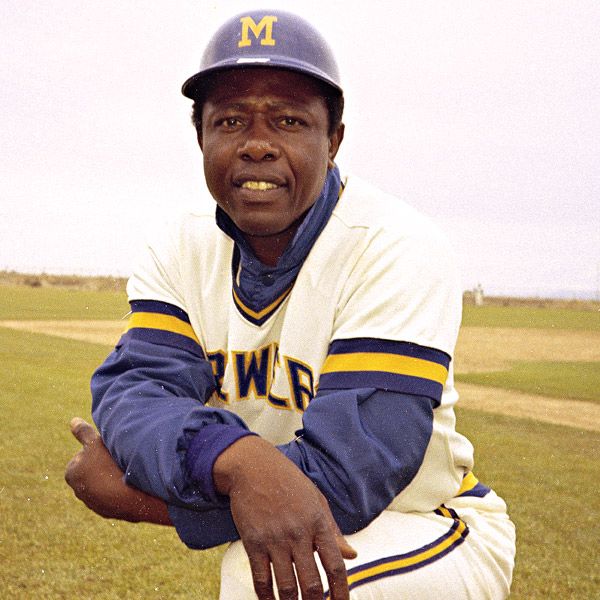
How Hank Aaron’s 745th home run sparked a lifelong love of baseball.
By September 1975, Hank Aaron was no longer in his prime. In his first season back in Milwaukee—wearing the powder-blue uniform of the American League’s Milwaukee Brewers—the 41-year-old Home Run King was nearing the end of his legendary career. Because Aaron had spent two decades crushing National League pitching with the Braves, New England fans never got to see him in person in a regular-season game. That changed on Sunday, September 14, 1975, when the Brewers faced off against the division-leading Boston Red Sox at historic Fenway Park.
It was a classic, early-fall Sunday afternoon in Boston. The temperature hovered in the mild 60s°F with a comfortable September breeze—ideal late-season baseball weather. A crowd of 28,187 fans packed the cozy confines of Fenway Park. The Red Sox were locked in a tense pennant race, holding down first place in the AL East as they marched toward their iconic 1975 World Series appearance. Yet, despite the postseason stakes for the home team, there was a palpable reverence whenever Aaron stepped into the batter’s box.
On the mound for Boston was eccentric left-hander Bill Lee. Lee, who relied on subtle changes of speed, breaking balls, and junk pitches rather than overpowering velocity, had already notched 17 wins on the season.
In the fifth inning, Hammerin’ Hank reminded Boston why his name sits atop the baseball galaxy. Facing Lee, Aaron unloaded on a pitch and sent a majestic, soaring drive high into the late-afternoon sky. The ball cleared the 37-foot Green Monster in left field with room to spare for his 745th career home run—his first and only round-tripper at Fenway Park.
Lee later joked in classic “Spaceman” fashion that serving up a home run to the legendary slugger was almost an honor—though he expected Aaron to retire that year so he could claim he gave up Hammerin’ Hank’s last long ball. Over the years, the story has been retold countless times, cementing its place in Red Sox lore and baseball history.
A Boy’s Eye View
What does this piece of history have to do with me? Simple: I was there. It was the first major league game I ever attended, and it ignited a lifelong passion for the game of baseball.
Everything at Fenway Park seemed gargantuan, but somehow I felt right at home.
Holding my dad’s hand, I walked through a dark, noisy tunnel that smelled like buttered popcorn and grilled sausages. My eyes were wide as I took in the crowd of fans wearing red caps with the iconic “B.” On top of my head sat one of my very own—and tucked safely under my dad’s arm was a blue Milwaukee Brewers cap he’d bought me as well. He gave me that one when we returned home, though sadly, both were lost to the passage of time.
My dad wasn’t cheering for Boston that day, though. He brought me to this specific game for one big reason: Henry Aaron. Aaron was my dad’s absolute favorite player, and he wanted to make sure I saw the Home Run King in person before he hung up his cleats. I had previously seen Hank on television when NBC broadcast his historic 715th homer on April 8, 1974, but seeing him in the flesh was different.
When we stepped out into the open air, my breath caught in my throat.
The grass was the greenest green I had ever seen—a giant, perfectly smooth carpet stretching out in front of us. Way out in left field, the wall rose like an emerald skyscraper. Dad pointed up at it, reminding me that I had seen “The Green Monster” on TV. I stared at it, half expecting a real monster to poke its head over the top. Instead, I saw hand-operated score numbers being slid into place by operators hidden inside.
Before we left home, my mother shook her head and warned my dad, “You’re going to let him eat too much junk, and he’s going to get sick.” Sitting in our wooden seats, feet dangling high off the ground, I was in ball-park heaven: a warm hot dog in one hand, a box of salty popcorn in my lap, and an ice-cold Coca-Cola between my feet. (For the record: I didn’t get sick at all.)
Each time Aaron stepped into the batter’s box, my dad squeezed my hand a little tighter, standing tall with a radiant smile. When the bat hit the ball with a sharp CRACK, the entire stadium erupted. I jumped up too, clutching my popcorn and clapping with all my might. I jubilantly participated in the standing ovation The Hammer got when he deposited that pitch into the net, mimicking my father’s joy at seeing the Home Run King do it again.
By the time the crowd stood up for the seventh-inning stretch, my fingers were sticky, my Coke was finished, and my legs were tired from jumping. I never wanted to leave. In a way, I never did.
A Lasting Legacy
As the autumn weather cools and the days shorten, I frequently return to that afternoon—the warmth, the ballplayers, and that historic home run. Most of all, I remember my father’s joy in sharing his favorite player and game with me. For a moment, I can still feel the summer sun on my face and shake off the cold. Though time has marched on and the game has changed over the decades, it remains the same beautiful thing at its core: the simple thrill of base hits and home runs, strikeouts and stolen bases, and all the timeless elements that make baseball so special.
In the decades since that autumn day at Fenway, I have witnessed countless other moments etched into the game’s rich tapestry. I was there when David Wells pitched his perfect game, watched Rickey Henderson break the all-time stolen base record, and felt the immense relief when the Red Sox finally reversed the Curse in 2004. Years later, I saw the Chicago Cubs break their own 108-year drought in equally heroic fashion. I’ve watched old cathedrals give way to modern ballparks, seen the game adapt to new rules like the pitch clock and expanded playoffs, and even witnessed the rare, solemn drama of a player banned from baseball for life. Yet even through all the changes and labor strife, I return. Every year, I return.
Gosh, I love this game.
A version of this article appeared the the Fall edition of Clyde’s Vibes, the newsletter of The Clyde Sukeforth All Star Chapter of SABR (ME/NH). For more information on SABR, click here.


